Friday, October 28, 2005
what is a "disciple"?
I'm looking to write a message arc on the subject of 'what is a "disciple"?' for my high school youth group. I'm interested in anyone's take on the subject. What do you think?


Wednesday, October 19, 2005
One Second
The idea for this thought came from my friend David Bellamy...
Have you ever thought about that increment of time we refer to as one second? It might not mean much to you, but this past Saturday night, it meant Penn State's first loss of the season to a team they were supposed to have no problem beating. In a nutshell, in the last second of the game, with Penn State up 25 to 21, University of Michigan's quarterback was able to move the ball up and into the Penn State's red zone (the 20 yards closest to the end zone). Forget the terrible calls by the refs which allowed this to happen in the first place (and despite your thoughts, I'm not on sour grapes). Instead, focus on the fact that with one second left in the game, Michigan was able to rocket a pass to an open receiver in the Penn State end zone. Poof. End of game.
What does one second mean in your life? It may not seem like much. And let's face it, few reading this e-newsletter will probably ever be in such a situation like the Penn State-Michigan game. But one second can have a profound effect, even in the midst of some of the more mundane, regular moments of our lives. One second is about the time it takes for each of us to go from thought to action. That is, one second is the time it takes for you to convert your thinking about doing or saying something into your actually doing or saying something. One second can mean the difference between something getting done or not. It can be the difference between your sharing something profound, or sticking your foot in your mouth.
One second can also have profound eternal consequences. It can mean the difference between spending eternity in the joyful presence of God, or spending in eternal damnation, separated from God. One second. The bible tells us that death comes to all people, with no bias toward economic status, education, race, or even religion. And on top of that, the bible says that everyone who dies will face judgment by God. Death can come as quick as one second. I just heard about a high school class mate and friend of mine who was killed in a car accident last month. I don't know exactly how he died. And I don't really know how quickly he died. But I've found myself wondering about where he is right now. Not too long after school ended this past June, an LM student suddenly died from a tumor near her heart. Did she have a chance to cry out to God? This is not meant as either a judgment on either of these people. But it is one of those 'in-your-face' kinds of questions for you. Do you know where you're going to spend eternity? One second can make a difference. If you're reading this, and you want to make an eternal difference in your life, here and now, drop me a line, and we can talk. One second. It could be the difference between life and death.
Have you ever thought about that increment of time we refer to as one second? It might not mean much to you, but this past Saturday night, it meant Penn State's first loss of the season to a team they were supposed to have no problem beating. In a nutshell, in the last second of the game, with Penn State up 25 to 21, University of Michigan's quarterback was able to move the ball up and into the Penn State's red zone (the 20 yards closest to the end zone). Forget the terrible calls by the refs which allowed this to happen in the first place (and despite your thoughts, I'm not on sour grapes). Instead, focus on the fact that with one second left in the game, Michigan was able to rocket a pass to an open receiver in the Penn State end zone. Poof. End of game.
What does one second mean in your life? It may not seem like much. And let's face it, few reading this e-newsletter will probably ever be in such a situation like the Penn State-Michigan game. But one second can have a profound effect, even in the midst of some of the more mundane, regular moments of our lives. One second is about the time it takes for each of us to go from thought to action. That is, one second is the time it takes for you to convert your thinking about doing or saying something into your actually doing or saying something. One second can mean the difference between something getting done or not. It can be the difference between your sharing something profound, or sticking your foot in your mouth.
One second can also have profound eternal consequences. It can mean the difference between spending eternity in the joyful presence of God, or spending in eternal damnation, separated from God. One second. The bible tells us that death comes to all people, with no bias toward economic status, education, race, or even religion. And on top of that, the bible says that everyone who dies will face judgment by God. Death can come as quick as one second. I just heard about a high school class mate and friend of mine who was killed in a car accident last month. I don't know exactly how he died. And I don't really know how quickly he died. But I've found myself wondering about where he is right now. Not too long after school ended this past June, an LM student suddenly died from a tumor near her heart. Did she have a chance to cry out to God? This is not meant as either a judgment on either of these people. But it is one of those 'in-your-face' kinds of questions for you. Do you know where you're going to spend eternity? One second can make a difference. If you're reading this, and you want to make an eternal difference in your life, here and now, drop me a line, and we can talk. One second. It could be the difference between life and death.
Wednesday, September 28, 2005
why tragedy?
Tragedy. Suffering. Pain. Loss. Evil. These are all issues of the real world, both inside and outside of the Church. Yet, too often, we as Christians are either silent at the wrong times (that is missing in action), or we speak with great selfishness (a self-righteousness that is separate from God's word). The parents of soldiers killed in Iraq over the last few years of war. The thousands of Iraqis who have lost parents, siblings, or children within that same conflict, and even before. And now before us are the latest to wrestle with these challengers to life, the survivors of Hurricanes Katrina, and now, Rita.
Why. A simple word that often requires an exceptionally demanding answer in the face of the deepest soul pain.
Tragedy has been before us, Christian and non-Christian alike. But what do we do with it? Evil has haunted our kind from almost the beginning. Today, we have never been so far from, yet so close to the answer to, the reason for not giving up all hope. In his book, Jesus Among Other Gods, Ravi Zacharias frames the ongoing wrestling match between the peaceful life we all desire, and the stomach-churning realities that many of us face via the ninth chapter of John's gospel. [I encourage you to read his book, even as I quote from it.] Zacharias speaks to the core of the question of why in the face of tragedy and evil.
By reframing our lives so that our view of all whom we know, and all whom we see (that is our neighbors - and who is my neighbor?), as through the framework of Jesus Christ, will we see that all people are created in the divine image of God. When Jesus healed the blind man, it was not to defend the Father from false assertions, but instead to show God's glory at work, that is, how the sacred love of God, through God's people, can meet and overcome evil. We may not see so many miracles like that today (oh that we should), but we can respond to tragedy, suffering, pain, loss, and evil like Jesus did. We can, through such terrible things, display the glory of God, and through that, worship this God who endured evil personally on our behalf. Tragedy is only as defeatable as is our willingness to love and worship a holy God in word and deed.
Why. A simple word that often requires an exceptionally demanding answer in the face of the deepest soul pain.
Tragedy has been before us, Christian and non-Christian alike. But what do we do with it? Evil has haunted our kind from almost the beginning. Today, we have never been so far from, yet so close to the answer to, the reason for not giving up all hope. In his book, Jesus Among Other Gods, Ravi Zacharias frames the ongoing wrestling match between the peaceful life we all desire, and the stomach-churning realities that many of us face via the ninth chapter of John's gospel. [I encourage you to read his book, even as I quote from it.] Zacharias speaks to the core of the question of why in the face of tragedy and evil.
"Not only is God holy, but He also reveals to us the sacred nature of love, to which He beckons us. And from this sacredness of His love must flow all other loves... The inability to understand the mystery of evil leads to an inability to understand the sacredness of love. A deadly mistake that I believe our cultures make in the pursuit of meaning is this illusion that love devoid of the sacred, a naked love, is all we need to carry us through life's tests and passions. Such love cannot sustain us... In fact, love by itself will make evil more painful. Love can only be what it was meant to be when it is wedded first to the sacred. Sacredness means separateness. Holiness beckons not just to love but moves in increments till it is climaxed in worship. What does all this have to do with suffering? Everything. You see, when the skeptic asks why God did not fashion us so that we would only choose good, he or she completely misses - drastically misses - what goodness is in God's eyes. Goodness is not an effect... But if life is born out of sacredness, neither goodness nor love aloneMy thoughts on this are simple, but, I do not think simplistic. Too many people speak to tragedy and evil from thoughtlessness or self-righteousness. We see that behind the disciples' question to Jesus about the blind man, "Rabbi, who sinned, this man or his parents, that he was born blind?" And this might have actually been one of their more thoughtful questions. But it was one that Jesus was able to speak to in a way that they, nor us, could equivocate. Jesus' answer, in word and deed, shows us how holiness and worship conquer evil. "Neither this man nor his parents sinned," said Jesus, "but this happened so that the work of God might be displayed in his life." Some might choose to see a "sick" kind of god behind such an answer - what kind of god would create or allow a person to be blind so that this god could get some credit? But such a response would miss the issue and the point. Interestingly, sacred and sacrifice share the same root. I think it no mistake that at root here is a truth that it is only when love originates from the sacred, and [that love] is acted upon, that is, expressed sacrificially, that we can answer evil in this world. And that answer is that a sacred sacrifice, that is a life lived for God, is worshiping God in the face of an evil that would seek to persuade or intimidate us into believing that God is either absent or altogether fake.
is the goal. It is reverence, and it must be chosen even when it is hard and costly. This kind of love is a choice to let the sanctity of life dictate the commitment of the will. This kind of reverential love can look upon suffering and see it beyond the clutches of time and through the victory of eternity... We all recognize a sacred love when we see it, and we long for it... Until we understand that kind of love we will never understand why it cannot be programmed. Nor, for that matter, will we ever grasp the true nature of evil. From worship flows this love. That is why God did not make us choose good. It is not goodness we are called to but worship... When that kind of love is expressed to God, every other love finds its cue... Only when holiness and worship meet can evil be conquered. For that, only the Christian message has the answer" (pages 128 - 130).
By reframing our lives so that our view of all whom we know, and all whom we see (that is our neighbors - and who is my neighbor?), as through the framework of Jesus Christ, will we see that all people are created in the divine image of God. When Jesus healed the blind man, it was not to defend the Father from false assertions, but instead to show God's glory at work, that is, how the sacred love of God, through God's people, can meet and overcome evil. We may not see so many miracles like that today (oh that we should), but we can respond to tragedy, suffering, pain, loss, and evil like Jesus did. We can, through such terrible things, display the glory of God, and through that, worship this God who endured evil personally on our behalf. Tragedy is only as defeatable as is our willingness to love and worship a holy God in word and deed.
Tuesday, September 20, 2005
real prayers
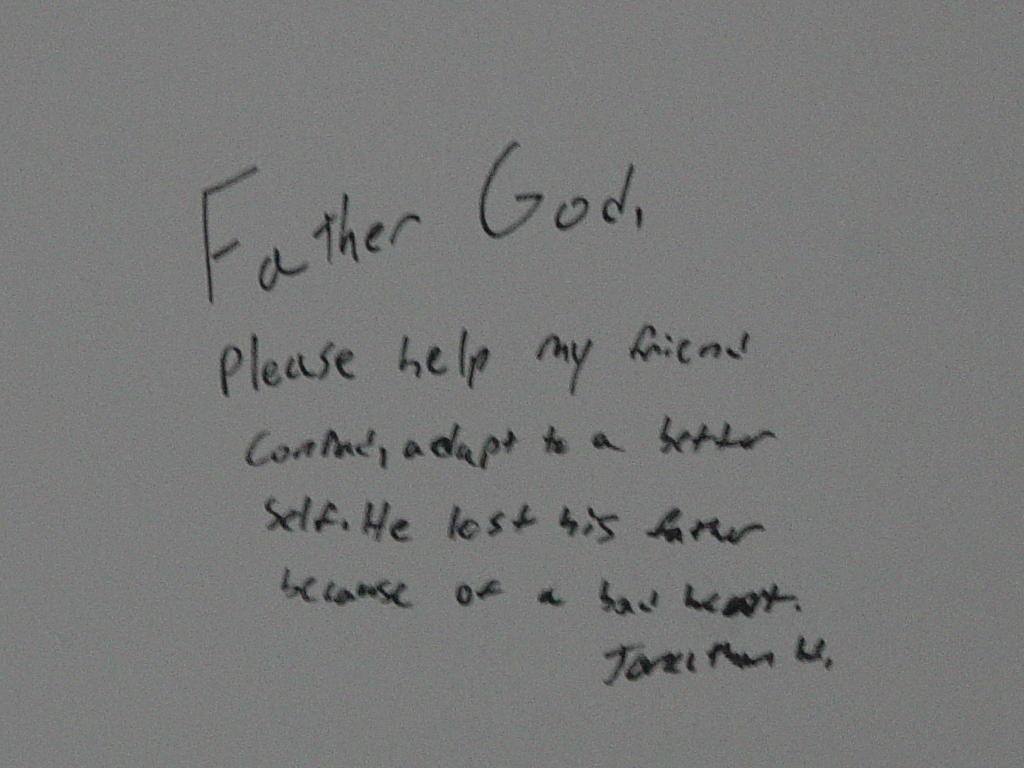

As I sit here writing, I am burdened by the fact that I am no expert in prayer. Last week, I "penned" an entry that asked the question, "Are you praying?" (see below), and in that offered some basic information that Christians should know, so as to give them, in the least, some sort of biblical idea and model of how to go about praying. But I'm no expert in prayer. Yes, I pray every day. With my wife, with my kids, and by myself. Somedays I do get to pray with collegues in ministry, fellow youth pastors, or with students. But I struggle with prayer. It doesn't come easy to me like it does for some. Call it spiritual ADD, call it being too busy, I don't know. I have a hard time sitting still, concentrating, focusing on the LORD, and even worse, I struggle to sit in the silence, waiting, listening. Yet I still pray. I'll use a variety of prayers. I'll pray free-style, I'll delve into a prayer written by an ancient brother or sister in the faith, or I'll read a prayer from a prayer book (I still love the collects contained in the Episcopal Book of Common Prayer - 1979 edition).
But I wanted to share with you some real prayers from students and youth ministers gathered this past Sunday morning at the kick off of our weekly Sunday morning offering, preworship. These prayers may seem unpolished at best, they may seem even a bit artificial in places, but they are first and foremost prayers from the hearts of each of these people. I seek to pray over and through these collected prayers throughout the week, so that our students and youth ministers know that what they've put down on paper is being taken seriously; that these prayers are treated with holy respect. Join me in lifting them up...
"That this year go well and lots of people do show up, have fun, grow in their faith."
"for this to be a great year for everyone to grow closer to God."
"For Foot - that she can play [field hockey] this week."
"the physical healing of Gilbert Ramerez, he is a minister in LA and Mexico."
"For students who have been away from YG and church to come back into the fold."
"My friend Cara's town was destroyed in hurricane Katrina and no one has heard from her. Pray for her and her family's safety."
"My mom's best friend needs a liver transplant."
These are the real prayers of real people. A few students and I started a prayer wall last Good Friday as part of a Spiritual Formation overnight. We even had two middle school students participate! It was quite wild. They were given permission to just listen to God, through music, taste, and recitation, and then given opportunities to respond. Out of that has come a sense among many students that they want to share with God, and with other students and adults, their heart, their needs, their fears. Let's all pray, for them, for us, that the LORD is His mercy will hear our prayers.
Monday, September 19, 2005
'you should know what to do by now'
Voice mail prompt messages are a funny thing, as I recently was made aware of. The current manifestation of the prompt for my cell voice mail is a good point. It merely says, "Hi, this is David. You should know what to do by now, so just do it." When I left it, I was merely trying to leave a prompt that was different than the typical, "Hi, this is David. I'm not here right now, so please leave your name, your message, and I'll get back to you as soon as I can" sort of message. While I didn't want to spend too much time being creative, whatever that all means, I did want something different, yet not so crazy as to confuse people. Hence, my current message.
But how interesting to discover that a friend, in trying to reach me, discovered some deeper, hidden meaning in the words of my prompt. In leaving me his message, a friend of mine replied something to the effect, "hey, this is a bit of a prophetic message. I should know what to do by now, so just do it? Hmmm. what are you trying to tell me?" And then he left the rest of his message (which has little to nothing to do with this blog). Perhaps this friend was merely in a very thoughtful mood. Then again, maybe the prompt struck him in his heart regarding what was going on his life at the time.
To me, the question begs to be asked, of myself, others, perhaps of you, 'do you know what to do?' Many of us claim ignorance as to why we don't 'do' something. We think, perhaps, that the sin of omission is far better than a sin of comission. Yet rather than a mere voice prompt, my friend heard not so much a digital recording of my voice, but more aptly a prompt from the Holy Spirit (no, I'm not confusing my voice with God's!). In hearing, 'you know what to do by now, so just do it,' maybe my friend's own spirit was pricked by words that spoke to his own [internal] struggles. Maybe we need to hear those words afresh. Maybe we need to reexamine our own hearts, and ask the Lord to show us, and speak into, those same hearts. What do you think?
But how interesting to discover that a friend, in trying to reach me, discovered some deeper, hidden meaning in the words of my prompt. In leaving me his message, a friend of mine replied something to the effect, "hey, this is a bit of a prophetic message. I should know what to do by now, so just do it? Hmmm. what are you trying to tell me?" And then he left the rest of his message (which has little to nothing to do with this blog). Perhaps this friend was merely in a very thoughtful mood. Then again, maybe the prompt struck him in his heart regarding what was going on his life at the time.
To me, the question begs to be asked, of myself, others, perhaps of you, 'do you know what to do?' Many of us claim ignorance as to why we don't 'do' something. We think, perhaps, that the sin of omission is far better than a sin of comission. Yet rather than a mere voice prompt, my friend heard not so much a digital recording of my voice, but more aptly a prompt from the Holy Spirit (no, I'm not confusing my voice with God's!). In hearing, 'you know what to do by now, so just do it,' maybe my friend's own spirit was pricked by words that spoke to his own [internal] struggles. Maybe we need to hear those words afresh. Maybe we need to reexamine our own hearts, and ask the Lord to show us, and speak into, those same hearts. What do you think?
Subscribe to:
Posts (Atom)